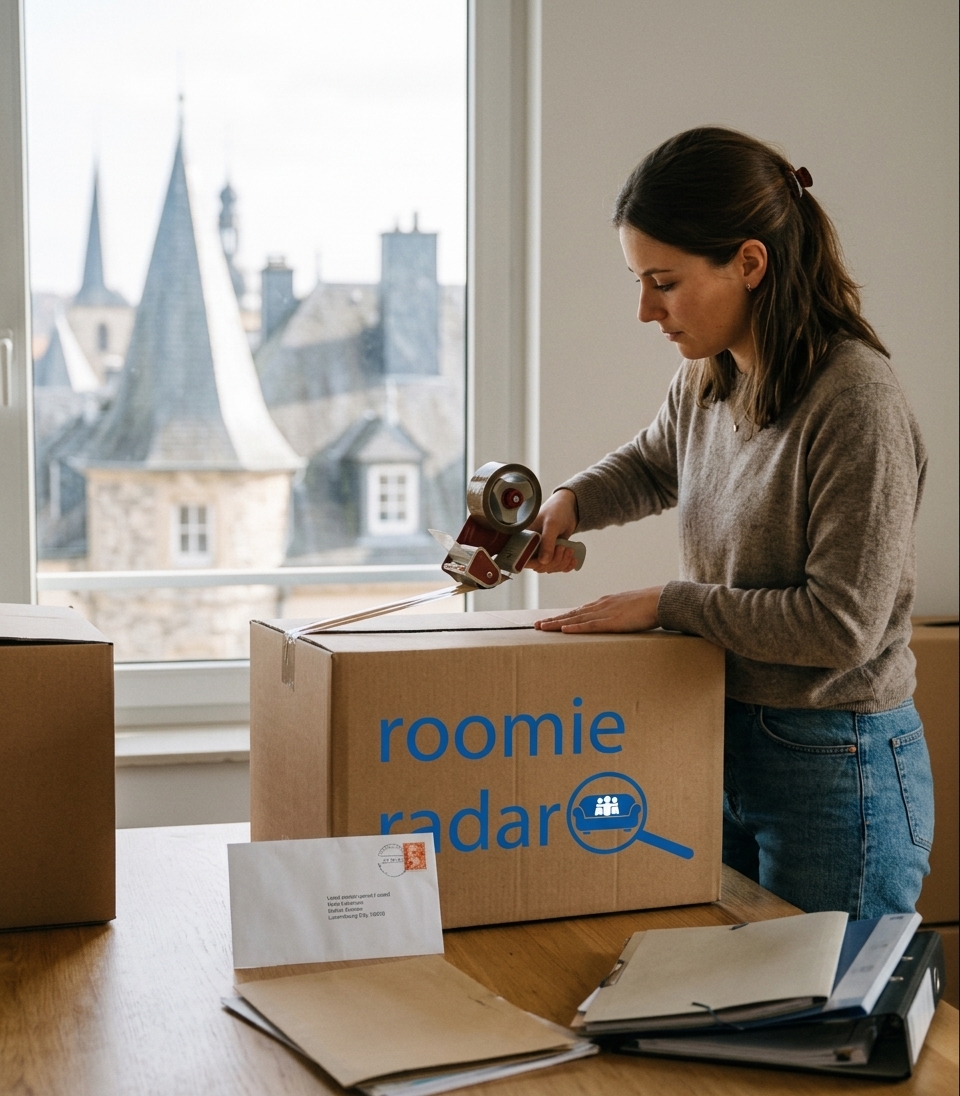
You land in Luxembourg with a signed contract and three weeks to find housing. You search online and find two types of listing: a "coliving, all-inclusive" at €1,100/month and a "room in a shared flat" at €750/month. Which do you choose?
Most expats arriving in Luxembourg make this decision based on price alone. The shared flat looks cheaper. The coliving looks easier. But the real difference between the two goes well beyond what you pay per month.
Since launching Roomie-Radar, we've found this is one of the most consistently misunderstood decisions among new arrivals — and one of the most consequential. This article gives you the full picture.
What is coliving and how does it differ from a flatshare in Luxembourg?
Coliving in Luxembourg is accommodation managed by an operator, where residents have a private room and access to shared spaces — kitchen, living area, sometimes a laundry or workspace — maintained by the operator. The contract is typically individual: each resident signs directly with the operator, not with the other residents.
A flatshare in Luxembourg — legally called co-location under Luxembourg law — is an arrangement where multiple tenants rent a property from the same landlord. Common areas are managed by the tenants themselves, without an operator.
The distinction matters immediately. In coliving, if a housemate leaves, the operator finds the replacement. In a flatshare, that falls on the remaining tenants.
Luxembourg's July 2024 rental reform formalised this distinction: co-location and co-living are now separate legal categories with different frameworks for liability and contract exit.
Luxembourg Rental Reform 2024: What Changed for Flatshare Tenants and Why It Matters Before You Sign
How much does each option cost? Real 2026 prices in Luxembourg
The price difference between coliving and a flatshare in Luxembourg is real, but the actual gap is smaller than it first appears when you compare the full monthly cost.

The flatshare price is the room only. Utilities — water, electricity, heating, internet — are split between tenants and typically add €80–€150/month. In coliving, the monthly price usually covers all utilities, wifi, and in some cases cleaning of common areas.
The real gap between the two options, once utilities are counted, is typically €150–€250/month in the same neighbourhood.
Can I register at the commune if I live in a coliving or flatshare in Luxembourg?
Yes — in most verified coliving and flatshare listings, commune registration is possible.
In Luxembourg, registering at your commune is mandatory for all residents and must be completed within days of arrival. It's required for obtaining a residence permit, accessing the healthcare system, and most administrative processes.
The key word is "verified": verified listings on Roomie-Radar correspond to landlords and operators with formal agreements in place, and domiciliation is possible in those properties. In unverified listings — particularly those circulating through Facebook groups — some landlords explicitly prohibit it or cannot guarantee it. Always confirm this before applying.
What does joint liability mean in a Luxembourg flatshare?
In a joint-contract flatshare in Luxembourg, all tenants on the same contract are jointly liable for the full rent. This means that if one flatmate stops paying, the landlord can claim the full outstanding amount from any of the remaining tenants.
This is the most important legal distinction between a flatshare and a coliving — and the one that most often surprises expats when a problem arises.
Luxembourg's July 2024 rental reform introduced the pacte de colocation and the colocataire référent precisely to give a legal framework to how co-tenants manage this internally. But the principle of joint liability towards the landlord remains in place.
In coliving, each resident has an individual contract with the operator. If one resident stops paying, that's a matter between them and the operator — it doesn't affect other residents.
When does coliving make more sense than a flatshare?
The right choice depends on three factors: length of stay, tolerance for administrative friction, and the real monthly cost after utilities.
Coliving in Luxembourg makes more sense when:
You're staying for less than six months and want to avoid complex contracts. You prefer a fixed monthly price with no utility surprises. You're looking for a community of residents from day one, particularly if you're arriving alone. Your employment contract is probationary or temporary and you need maximum exit flexibility.
A flatshare in Luxembourg makes more sense when:
Your stay will be six months or longer and you can manage utilities. You're prioritising budget — the €150–€250/month gap adds up to €1,800–€3,000 over a year. You already know someone in Luxembourg to share with, or you're able to search for flatmates independently. You prefer more privacy and autonomy.
Many Roomie-Radar users start in a coliving for the first two to three months — to settle in, explore neighbourhoods, and understand the market — then move to a longer-term flatshare. It's a strategy that works well in Luxembourg because the flatshare market is more favourable when you're searching without urgency.
How Much Does It Cost to Live in Luxembourg in a Shared Room: A Real Monthly Budget
Why this choice also matters for landlords and coliving operators
For a landlord or coliving operator in Luxembourg, the type of structure you offer determines the candidate profile you attract and the legal mechanisms available if something goes wrong.
A coliving operator publishing verified listings on Roomie-Radar reaches qualified candidates looking for individual flexible contracts. A flatshare landlord reaches candidates with longer-stay profiles and more autonomy in day-to-day flat management.
Both profiles exist on the platform. What Roomie-Radar does is match each type of accommodation with the candidates whose needs fit — not send the same generic application to every listing.
Conclusion
Choosing between coliving and a flatshare in Luxembourg is not just a price decision. It affects your contract structure, your legal liability, your ability to register at the commune, and your day-to-day living experience.
If you're arriving for a short period, want zero administrative friction, and can absorb the higher price, coliving is the more straightforward option. If your stay is longer and you want to optimise your monthly budget, a well-chosen flatshare with a clear contract gives you better financial margin.
At Roomie-Radar you'll find verified listings of both types across Luxembourg. Start your search at roomie-radar.com or browse directly at roomie-radar.com/rooms. Using Roomie-Radar is free.
FAQ 📊
1. What is the difference between coliving and a flatshare in Luxembourg?
Coliving in Luxembourg is managed by an operator: each resident has an individual contract and utilities are usually included in the price. A flatshare involves multiple tenants sharing a contract with the same landlord, managing utilities between themselves, and bearing joint liability for the rent. Since Luxembourg's July 2024 rental reform, the two are separate legal categories with different frameworks for liability and exit.
2. How much does coliving cost in Luxembourg in 2026?
A coliving space in Luxembourg costs between €820 and €1,300/month all-inclusive, depending on the neighbourhood. In Bonnevoie and Hollerich the range is €820–€1,000; in Luxembourg City centre, €950–€1,200; in Kirchberg, €1,050–€1,300. In Esch-sur-Alzette prices drop to €700–€900. The price typically includes utilities, wifi, and in some cases cleaning of common areas.
3. Can I register at the commune if I live in a coliving in Luxembourg?
Yes, in most verified coliving spaces. Commune registration is mandatory in Luxembourg for all residents and must be completed within days of arrival. Verified listings on Roomie-Radar correspond to operators and landlords with formal agreements that include domiciliation. For unverified listings, confirm this with the landlord before applying.
4. What is joint liability in a Luxembourg flatshare and how does it affect me?
In a joint-contract flatshare, all tenants are jointly liable for the full rent. If one flatmate doesn't pay, the landlord can claim the outstanding amount from any remaining tenant. This liability exists regardless of any internal arrangement between tenants. In coliving, each resident has an individual contract and there is no joint liability between residents.
5. Is a flatshare cheaper than coliving in Luxembourg?
The headline room price is lower in a flatshare, but the real difference is smaller once utilities are included. Utilities split between tenants typically add €80–€150/month to a flatshare. The actual gap between the two options in the same neighbourhood is usually €150–€250/month. Coliving prices are all-inclusive; flatshare prices are not.
6. Can I leave a flatshare before the contract ends in Luxembourg?
Under the July 2024 rental reform, the departing tenant must give three months' notice to both the landlord and remaining co-tenants, and has an active obligation to find a replacement. In coliving, the operator manages the replacement process and exit is typically more straightforward.
7. When does coliving make more sense than a flatshare in Luxembourg?
Coliving makes more sense for stays under six months, when maximum exit flexibility is needed, when a fixed all-inclusive price is preferred, or when arriving alone and community is valued from day one. A flatshare makes more sense for longer stays where optimising monthly budget is the priority.
8. Does Roomie-Radar list both coliving spaces and shared flats in Luxembourg?
Yes. Roomie-Radar publishes verified listings of both types across Luxembourg — shared flat rooms and coliving spaces. Tenants can filter by accommodation type, price, contract duration, and neighbourhood. Using Roomie-Radar is free.