Every year, thousands of students and interns arrive in Luxembourg with a letter of acceptance or an internship contract in hand — and no idea where they're going to sleep.
The student accommodation in Luxembourg market is, to put it plainly, one of the most competitive in Europe. The University can only house approximately 1 in 6 eligible students. Private rentals receive 15 to 20 applications within 48 hours of a listing going live. And a room in a shared apartment in Luxembourg — not a studio, just a room — realistically starts at €600 per month in cheaper neighbourhoods like Bonnevoie or Esch-sur-Alzette.
We've seen too many people arrive without housing and spend their first weeks burning through savings in Airbnbs while frantically WhatsApp-messaging strangers from Facebook groups. That's the situation we want to help you avoid.
What Does Student Housing in Luxembourg Actually Cost? 💶
Before searching, you need realistic numbers:
- University residences (Uni.lu): €400–1,000/month, all-inclusive. Smallest rooms are 15m². The problem: not guaranteed.
- Private shared room (flatshare): €600–900/month in accessible areas; €900–1,200 in Kirchberg or Belair.
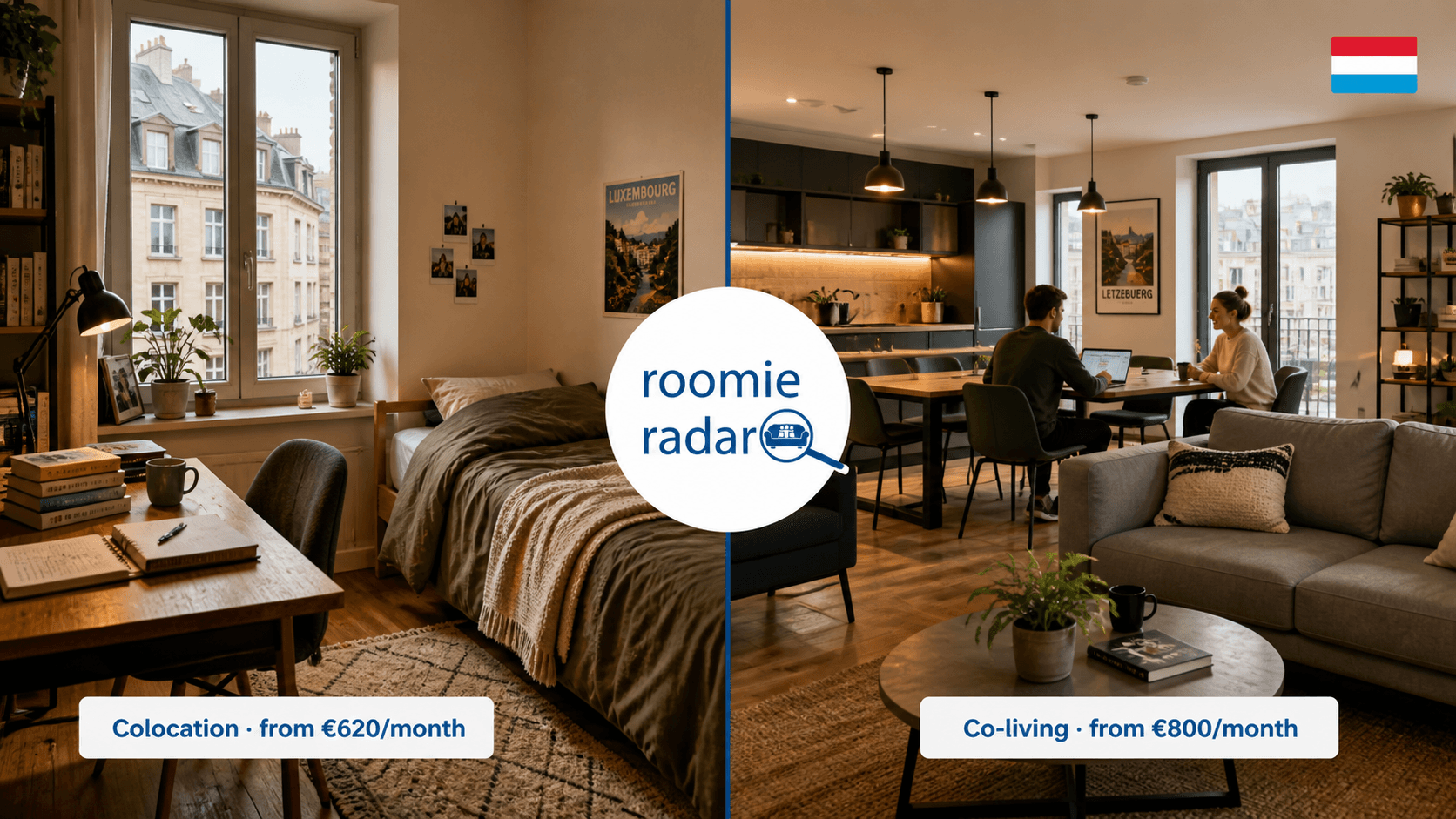
- Co-living: €800–1,200/month. More expensive than a flatshare but fewer headaches and flexible contracts.
- Solo studio: €1,400–1,800/month in the city. Out of range for most students without a salary.
Picture this: you arrive in Luxembourg in September, the university emails you a waitlist notification, and you have two weeks to sort housing. Without a pre-arranged room, you're looking at hostels or short-term rentals at €50–80 per night — €1,000+ burned before your first lecture. This is not an edge case. This is what happens to a substantial number of our Roomie-Radar users who arrive improvising.
The 4 Real Housing Options for Students in Luxembourg 🏠
1. University of Luxembourg Residences
The university manages over 36 residences, mostly near the Belval and Kirchberg campuses. Demand consistently exceeds supply, and the institution explicitly states it cannot guarantee housing for all applicants. Applications for the 2026-2027 winter semester open with limited advance notice — if you're not in the first wave, you go on a waiting list, and any offer made must be accepted within 10 days or it's gone.
A deposit of one month's rent plus a €350 (rooms) or €500 (studios) security deposit is required. Home insurance with a Luxembourg-approved provider is mandatory.
The Paper That Could Ruin Your Month: Individual Lease vs. Colocation Pact!
2. Wunnraum Fir Stagiairen (wfs.lu)
For interns of any nationality, this non-profit is one of Luxembourg's most underused resources. Four residences across the Grand Duchy, furnished rooms with internet, priced between €400 and €750/month. You need to submit an application with your internship contract documentation. All information is at wfs.lu — the process isn't instant, so apply early.
3. Private Flatshare (Colocation / WG)
This is how most students end up finding housing. The private market for cheap rooms to rent in Luxembourg operates mainly through platforms like Athome.lu, Immotop.lu, and Facebook groups like "Colocation Luxembourg / WG Lëtzebuerg." And this is where the problems start.
Scam listings targeting newcomers are genuinely common. Suspiciously perfect photos, below-market prices, a landlord who insists you send a bank transfer to "secure the room" before any visit. The classic move. The only reliable protection is ensuring the listing comes from a source that has physically verified the property.
At Roomie-Radar, every listing has been visited in person. Someone has gone to the address, confirmed the property matches the photos, and checked that the contract terms are real. For an expat searching for a room for rent in Luxembourg from abroad, this makes the difference between a smooth move and an expensive disaster.
The 2026 Master Guide: How to Rent a Room in Luxembourg Without Scams and the Power of Verification
4. Co-living: Less Bureaucracy, More Flexibility
Co-living in Luxembourg has expanded meaningfully in recent years. Operators offer furnished rooms, all-inclusive pricing, and flexible lease terms. The price point (€800–1,200/month) sits above a private flatshare. But for a 3–6 month internship or exchange semester, the reduction in administrative friction can genuinely be worth the premium — no hunting for housemates, no negotiating utility splits, no complicated deposit arrangements.
The Best Neighbourhoods for Students in Luxembourg 📍
Not all of Luxembourg City costs the same. What we've seen across our listings:
- Bonnevoie: The student favourite. Rooms from €600–800, strong connections to the central station and city centre via bus and tram.
- Hollerich / Gasperich: Developing area, slightly lower prices, good tram access.
- Esch-sur-Alzette: The go-to for Belval Campus students. Noticeably cheaper than the capital (€500–700 for a shared room), real student atmosphere.
- Kirchberg: Expensive (€800–1,100 for a room) but strategically placed for EU institutions, banks, and the Kirchberg campus.
- Gare / Limpertsberg: Well-connected, mid-range prices.
One thing that changes the entire calculation: public transport in Luxembourg has been completely free for all residents since 2020. Living in Esch-sur-Alzette and studying in Kirchberg costs nothing in commuting. This is genuinely significant when building a student budget.
Housing Aid: Can Students Access Any Financial Support? 💡
This is where things get confusing. Luxembourg does have housing assistance mechanisms — aide au logement administered through the Housing Ministry, processed via Guichet.lu — but eligibility depends heavily on employment status and tax contributions. Most exchange students and interns will find access limited or non-existent under the current criteria.
The honest answer: check Guichet.lu directly. Don't assume you qualify, and don't assume you don't. The SEVE student services department at the University of Luxembourg can also clarify your specific situation.
Why This Matters for Property Owners Too 🔑
If you own property in Luxembourg with spare rooms, the student and intern market is one of the most predictable rental segments in terms of turnover. Exchange students typically need 5–7 month contracts. Interns, 3–6 months. Clear start and end dates, usually with strong institutional backing (university letters, internship contracts).
The challenge for landlords in this segment isn't demand — it's verifying tenant profiles efficiently. Many students arriving through Roomie-Radar carry contracts from EU institutions, multinational companies, or accredited universities. The financial backing is often solid despite the absence of a local rental history.
Roomie-Radar streamlines this match: landlords post with the confidence that candidate profiles have been validated, and tenants know the property has been physically verified. Less wasted time on both sides.
The Ultimate 2026 Guide: How to Maximize Your Luxembourg Property ROI Through Co-living
The Real Verdict: What Official Guides Won't Tell You
Student housing in Luxembourg is harder than any official source will admit. The university cannot absorb demand. The private market moves faster than most newcomers can respond. Facebook groups mix legitimate listings with well-disguised scams. And arriving without housing means burning money on emergency accommodation before you've even started.
What actually works: starting the search 8–12 weeks before arrival, using platforms with physical verification, considering neighbourhoods outside the city centre, and accepting that a verified shared apartment in Luxembourg at €600–900 is not a compromise — it's the standard solution for most students and interns who land here successfully.
Conclusion
Student and intern housing in Luxembourg is a genuine challenge, but not an unsolvable one. The resources exist — from Uni.lu residences to Wunnraum Fir Stagiairen, from co-living operators to verified private flatshares — but you need to know they exist and move fast.
At Roomie-Radar, we list physically verified rooms in the neighbourhoods most sought by students and interns, with clear contracts and no hidden surprises. If you're heading to Luxembourg to study or intern, start your search at roomie-radar.com.
FAQ 📊
1. Are Facebook groups safe for finding student accommodation in Luxembourg?
Proceed with caution. Groups like "Colocation Luxembourg / WG Lëtzebuerg" contain genuine listings, but also a significant proportion of scams: fake photos, requests for bank transfers to "reserve" a room, non-existent contracts. The rule: never pay anything without a physical visit or independent verification of the property. If you're searching from abroad, a platform that has physically visited the listing is essential.
2. Can students access Luxembourg's state rental guarantee?
The Garantie Locative de l'État is primarily designed for people employed in Luxembourg who struggle to cover the deposit. For students without a Luxembourg employment contract, access is generally restricted. If you have a paid internship contract, the situation may differ. Consult Guichet.lu or the SEVE student services directly for your specific case rather than assuming eligibility either way.
3. Co-living or private flatshare — which is better for a student in Luxembourg?
It depends on your stay length and budget. Co-living in Luxembourg (€800–1,200/month) costs more but offers flexible terms, everything included, and minimal admin — ideal for stays of 3–6 months. A private flatshare in Luxembourg (€600–900/month) is cheaper but requires more effort: finding housemates, negotiating bills, verifying the contract. For stays over 6 months, a verified flatshare is typically better value.
4. Which neighbourhoods are cheapest for students in Luxembourg?
Bonnevoie and Hollerich offer the best value in Luxembourg City (€600–800 per room). Esch-sur-Alzette is the most affordable option for Belval Campus students, with rooms sometimes starting from €500–700. Keep in mind that public transport is entirely free across the Grand Duchy since 2020, which significantly reduces the cost advantage of living close to campus.
5. When should I start looking for student accommodation in Luxembourg?
At minimum 8 weeks before your arrival date, ideally 12. For the autumn semester (September start), begin in June or July. For the spring semester (February start), start in November. The most common mistake we see from Roomie-Radar users is waiting until all paperwork is confirmed before starting to search — by then, the best options are gone.
6. Does Roomie-Radar have rooms available for students and interns?
Yes. Roomie-Radar lists physically verified rooms in shared flats across Luxembourg's most popular student and intern neighbourhoods — Bonnevoie, Kirchberg, Gasperich, Esch-sur-Alzette. Every listing has been visited in person. Browse current availability at roomie-radar.com/rooms.