
Renting a room in Ghent or Antwerp: how Flemish rental rules differ from Brussels
Renting in Ghent or Antwerp? Deposit caps, EPC-linked indexation, and the Flemish rules that aren't the same as Brussels.
31/08/2026


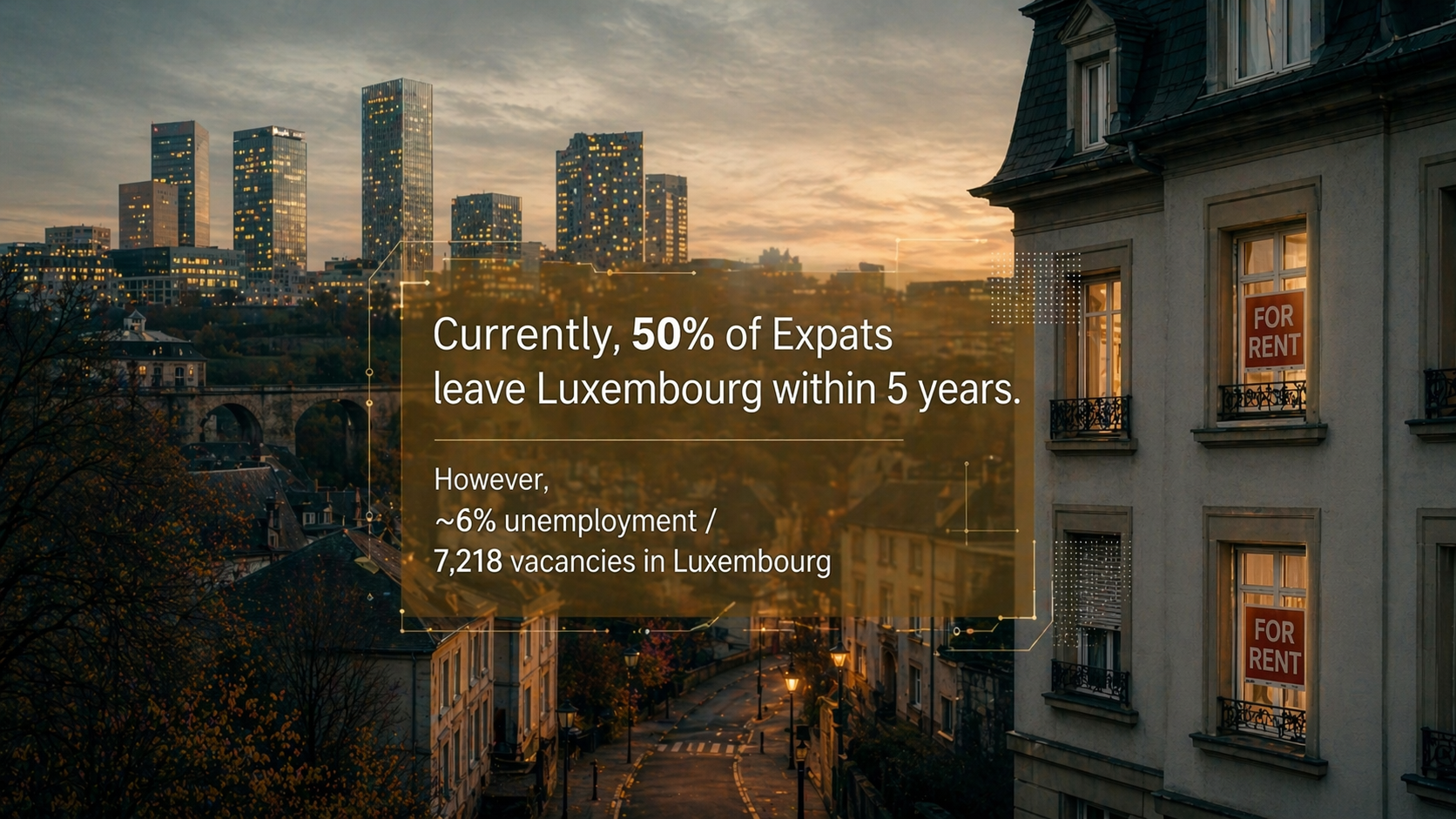
Luxembourg has a problem nobody in government wants to name directly. On one hand, the Grand Duchy attracts thousands of international professionals every year — in 2024, approximately 8,200 foreign workers entered the Luxembourg labour market for the first time, and nearly 90% of all first-time entrants were born outside the country. On the other hand, the LUXTALENT study published on 24 March 2026 by the Ministry of the Economy and the Luxembourg Institute of Socio-Economic Research (LISER) confirmed something that many residents already sensed: 50% of those international talents leave within five years of arrival.
At the same time, unemployment in the Grand Duchy was approaching 6% at the end of 2025 — one of its highest levels in a decade — while ADEM registered 7,218 unfilled vacancies in finance, technology, engineering, and healthcare. The headline nobody expected in Europe's wealthiest country per capita: rising unemployment and thousands of unfilled positions simultaneously.
This is not a talent supply problem. It's a retention problem. And at the centre of that retention crisis is a factor that business leaders, economists, and expats themselves are identifying with increasing clarity: the cost of housing in Luxembourg.
The LUXTALENT study — commissioned by the Luxembourg Government from LISER in March 2025 and published in its first part in March 2026 — is the most comprehensive analysis of talent attraction and retention in the Grand Duchy to date. Its methodology is noteworthy: rather than analysing the total stock of active workers (the standard approach in most prior studies), it adopted an innovative flow-based analysis of entries and exits from the labour market between 2002 and 2024, based on administrative data from the General Inspectorate of Social Security (IGSS), covering all individuals affiliated with Luxembourg's social security system.
The study highlights the growing importance of foreign workers in Luxembourg. Between 2002 and 2024, the number of first-time entrants to the Luxembourg labour market who were born abroad increased significantly.
But the most striking finding is the reverse: the study highlights the quality and diversity of talent attracted to Luxembourg, as well as the difficulty of retaining it — fifty percent leave within five years.
The second part of the study, expected in summer 2026, will analyse the specific factors that drive new arrivals to leave — or stay. But housing market data already points clearly toward where those conclusions will land.
To understand why this matters, it's worth pausing on the statistical paradox that RTL Today and labour economists have been analysing for months.
A concrete example: Luxembourg's unemployment rate continued rising, reaching 5.9% in October 2025, despite 7,218 open vacancies at the same period. This has been a recurring phenomenon for several years.
The unemployment rate is expected to remain high, at around 6%, declining significantly only from 2027 onwards, against a backdrop of slowing labour force growth, according to STATEC projections.
How is it possible that Europe's wealthiest country per capita has simultaneously rising unemployment and thousands of unfilled positions? The answer lies in a skills mismatch — a gap that sharpens precisely because qualified professionals leave before becoming a stable part of Luxembourg's labour ecosystem.
Some of these vacancies in skilled positions are not filled by people receiving unemployment benefits, but by workers transitioning from one job to another in search of better conditions. This creates a vicious cycle: the departing employee leaves another vacancy behind.
In 2026, ADEM's updated shortage occupation list covers 22 sectors — from IT and finance to industrial engineering and healthcare. For these professions, the Government has established accelerated hiring processes for foreign candidates. The signal is unambiguous: Luxembourg needs international talent. The challenge is keeping it.
Renting in Luxembourg on Probation: The Master Guide to the Période d'Essai and State Guarantees
In 2026, Luxembourg business leaders surveyed by LuxTimes identified cost of living — and specifically housing — as the single biggest barrier to attracting and retaining international talent in the Grand Duchy. Not tax rates. Not language. Not the general quality of life. The price of a roof.
The numbers justify that perception with striking force:
Rent in Luxembourg is, on average, 105.3% higher than in Germany. That rental premium reflects Luxembourg's severe housing shortage rather than any particular difference in the price of food or services. Housing prices in Luxembourg are 87% higher than the EU average.
As of early 2026, advertised rents in Luxembourg City are projected to grow by 2–4% over the full year, with prime districts at the higher end. Key drivers include persistent housing supply shortages, continued population growth from international workers, and a tight labour market.
For an international professional arriving in Luxembourg with a competitive salary but no prior knowledge of the local housing market, the impact is immediate. A one-bedroom apartment in Luxembourg City averages between €1,800 and €2,200 per month. For someone on a probationary period, a temporary contract, or simply in the first months of adaptation, that isn't just expensive — it can be financially unworkable.
The most common and realistic alternative for most newly arrived expats is a shared room in Luxembourg — private rooms running €620–€1,100/month depending on the neighbourhood. It's a functional solution, but one that requires navigating a fragmented market with scam risk and no centralised, reliable platform.
The 2026 Master Guide: How to Rent a Room in Luxembourg Without Scams and the Power of Verification
Luxembourg salaries are, objectively, among the highest in Europe. The average salary in Luxembourg reflects a premium financial services economy, with a strongly multilingual environment where 56% of the population has English proficiency. The tax system is relatively efficient. Public transport is free. Public services are high quality.
So why does half the talent leave?
The answer relates to what economists call the "net outcome" — what remains after deducting living costs. Success in Luxembourg depends on controlling housing and understanding net outcome, not just gross pay. High income potential is meaningful only after rent and mandatory contributions are accounted for.
For a single individual with no dependants, the recommended adjusted monthly budget in Luxembourg in 2026 is approximately €4,318. In that budget, rent represents between 35% and 50% of total expenditure, depending on housing type.
For an expat arriving on a 12 or 24-month contract — with no certainty of renewal — the long-term maths of staying don't always work. If net salary is competitive but rent consumes half of it before any other expense, the emotional and financial calculation of relocating to a city with a lower cost of living (Berlin, Lisbon, Madrid, or even the Greater Region across Luxembourg's borders) becomes increasingly attractive.
Luxembourg is now seeing residents moving across its borders to the Greater Region because prices there remain more reasonable, even though they have also risen significantly.
The picture is complex but not discouraging — if understood clearly. Luxembourg remains one of Europe's best labour markets for qualified professionals in finance, technology, law, and healthcare. The opportunities are real. The quality of life, once housing is sorted, is genuinely high.
The problem isn't Luxembourg as a destination — it's the friction of the first months. The expat who arrives without pre-arranged housing spends €1,000–€1,500 on emergency accommodation before finding a stable solution. The one who signs the first contract they find without reading it carefully may lose part of their deposit at move-out. The one searching Facebook groups may waste weeks on listings that don't exist.
That initial friction — costly, stressful, avoidable — is precisely what Roomie-Radar was built to eliminate. Verified rooms, clear contracts, free platform for tenants. We won't solve Luxembourg's housing market. But we can make the first steps less likely to be the reason someone decides not to stay.
Luxembourg Neighbourhoods for Expats: What Room You Can Actually Afford and Where to Search in 2026
Talent retention isn't only a government or employer problem. It's also a challenge for property owners renting rooms in Luxembourg.
A market where international talent leaves within five years is a market with structurally high turnover. That means more time finding tenants, greater vacancy risk, and higher management costs. The alternative — a market where expats integrate, stay, and renew contracts — is better for everyone.
Landlords listing on Roomie-Radar access a qualified user base with work contracts, arriving with genuine urgency and readiness to sign. That's not just a benefit for the tenant. It's a benefit for the property owner who wants to minimise the gap between one contract and the next.
The Ultimate 2026 Guide: How to Maximize Your Luxembourg Property ROI Through Co-living
The second part of the LUXTALENT study, expected in summer 2026, will provide qualitative data on why international talent leaves. But the quantitative data is already on the table, pointing in the same direction that Luxembourg's business community is flagging: cost of living, with housing at its epicentre, is the dominant factor in the decision to stay or go.
The Luxembourg Government launched the "Work in Luxembourg" brand in 2026 to promote the country as a professional destination. It's a necessary initiative. But no marketing campaign competes with the reality that a competitive salary doesn't translate to comfortable living when half of it disappears into rent.
The long-term solution is structural: more housing supply, more verified accessible options, more alternatives to full apartments for expats on temporary contracts. Roomie-Radar doesn't resolve Luxembourg's housing crisis. But it can be part of the infrastructure that makes staying easier.
The LUXTALENT study has put in writing what many Luxembourg expats already knew from experience: arriving is relatively straightforward; staying is considerably harder. The 50% departure rate within five years isn't an abstract statistic — it's the story of thousands of professionals who ran the numbers and concluded that the cost of living didn't align with their long-term plans.
For those arriving in Luxembourg today, the first step to shifting that equation is solving accommodation intelligently: verified room, transparent price, clear contract. That's exactly what Roomie-Radar lists. roomie-radar.com.
1. What did the LUXTALENT study reveal about talent retention in Luxembourg?
The LUXTALENT study, published by Luxembourg's Ministry of the Economy and LISER on 24 March 2026, found that 50% of newly arrived international workers leave Luxembourg within five years of arrival. The study analysed labour market entry and exit flows from 2002 to 2024 using administrative data from the IGSS. In 2024, around 8,200 foreign workers entered the Luxembourg labour market for the first time, and 90% of all new entrants were born outside the country.
2. What is Luxembourg's unemployment paradox in 2025–2026?
Luxembourg faces a documented macroeconomic paradox: unemployment reached 5.9% in October 2025 — one of the highest levels in over a decade — while 7,218 vacancies remained unfilled simultaneously. STATEC projects the rate will remain around 6% until 2027. The explanation is a skills mismatch: open positions require highly specialised profiles that the local market cannot supply, while registered unemployed workers often don't hold those qualifications.
3. Why is the cost of living in Luxembourg a barrier to retaining international talent?
Luxembourg business leaders identified cost of living — particularly housing — as the primary obstacle to retaining international talent in 2026 LuxTimes surveys. Rent in Luxembourg is on average 105% higher than in Germany and 87% above the EU average. A one-bedroom apartment in Luxembourg City averages €1,800–€2,200/month. For an expat on a temporary contract, this financial equation often doesn't justify committing to Luxembourg long-term over other European cities with lower housing costs.
4. How much does a shared room cost in Luxembourg in 2026?
A private room in a shared apartment in Luxembourg runs €620–€1,100/month depending on the neighbourhood. The most accessible areas are Hollerich and Bonnevoie (€620–€800), while Kirchberg or Belair exceed €900. Managed co-living in Luxembourg, all-inclusive, ranges from €800–€1,200. For newly arrived expats on a defined budget, a verified flatshare is typically the best balance between price and practicality.
5. Which sectors face the biggest talent shortages in Luxembourg in 2026?
ADEM's 2026 shortage occupation list covers 22 sectors. The most critical include information technology, industrial engineering, finance and banking, healthcare and social work, legal and compliance, and transport. For these profiles, the Government offers accelerated hiring processes for foreign candidates, including fast-track visa and work permit procedures. The reduction from 24 to 22 sectors reflects marginal improvements, not a structural resolution.
6. Why do expats decide to leave Luxembourg?
Based on data available ahead of the LUXTALENT Part 2 (expected summer 2026), the most documented departure factors are housing costs, friction during the initial months (bureaucracy, accommodation, social integration), and comparison with European alternatives offering lower living costs. Luxembourg competes on salaries but loses the comparison when real net purchasing power is analysed after deducting housing expenses. Living in the Greater Region (Germany, France, Belgium) and commuting to work in Luxembourg is an increasingly widespread alternative.
7. What is the Luxembourg Government doing to attract and retain talent?
The Government launched the "Work in Luxembourg" brand in 2026 to promote the country as a professional destination. It also maintains the High Committee for Talent Attraction, Retention and Development, chaired by the Minister of the Economy. 2025–2026 work permit reforms include raising the EU Blue Card salary threshold (€63,408 annually), grace periods for expats who lose their jobs, and simplified processes for shortage occupations. The LUXTALENT Part 2 is expected to generate specific policy recommendations.
8. How does Roomie-Radar help address the housing friction for Luxembourg expats?
Roomie-Radar doesn't solve Luxembourg's structural housing crisis. What it does is eliminate the search friction that defines the first months: verified rooms, free platform for tenants. Housing arrangements in the first weeks frequently determine whether a newly arrived expat has a positive or stressful initial experience. Reducing that friction — organised accommodation before arrival, transparent pricing, no scams — is a concrete contribution to real talent retention. Browse available rooms at roomie-radar.com/rooms.
9. Is Luxembourg genuinely more expensive than other European countries?
Yes, particularly for housing. Rent in Luxembourg is 105% higher than in Germany, 87% above the EU average, and Luxembourg City rental prices reached €35.61/m²/month in February 2026 — a 4.31% year-on-year increase. That said, salaries are proportionally higher, meaning purchasing power can be positive if housing is managed well. Shared rooms and co-living are the most effective tools for balancing that equation without sacrificing quality of life.
Renting in Ghent or Antwerp? Deposit caps, EPC-linked indexation, and the Flemish rules that aren't the same as Brussels.

Do you need tenant insurance in Luxembourg? It isn't required by law, but almost no lease gets signed without it. Here's why.

Coliving or flatshare in Brussels? Real prices, the colocation pact, and when each option actually makes sense before you sign.

Need to end your rental in Luxembourg? Notice period, required format, and what changes depending on who ends the contract.
