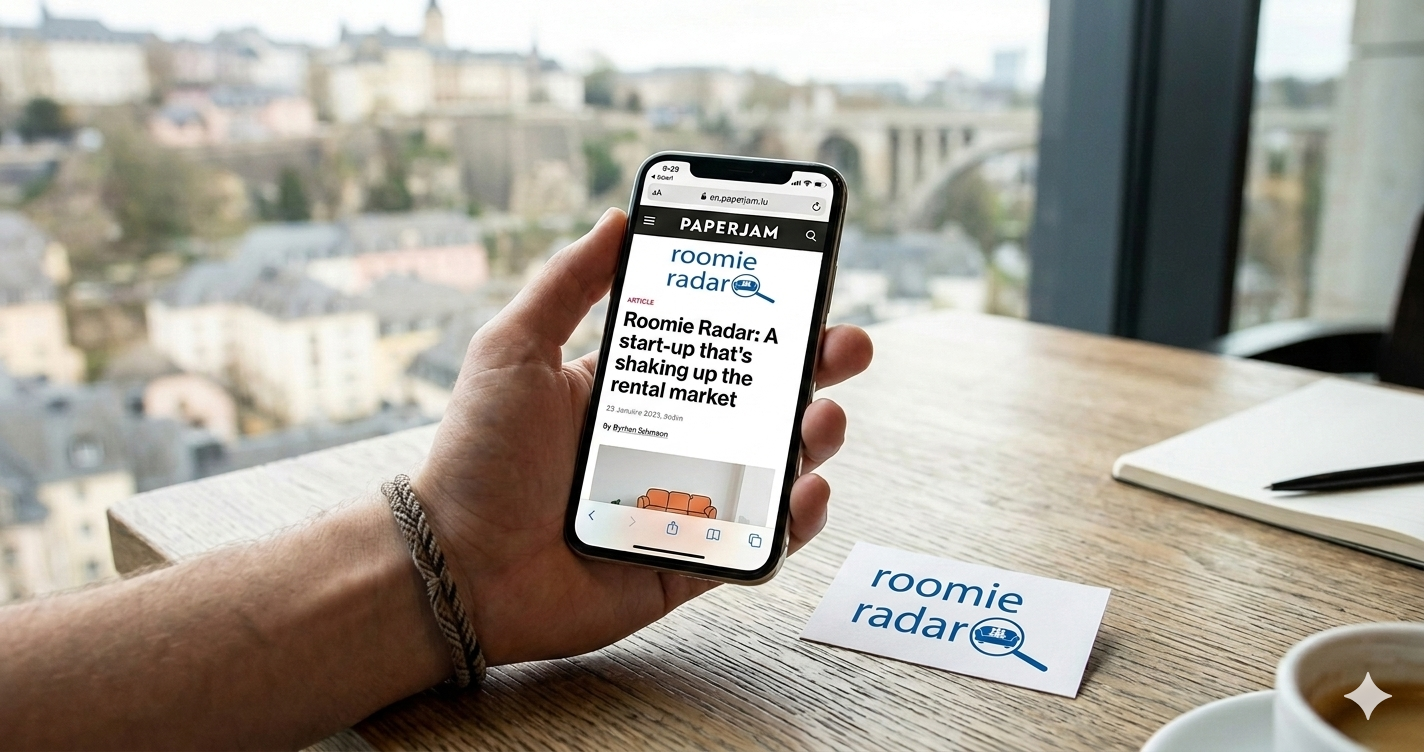
Finding a room in Luxembourg when you've just arrived shouldn't be this hard. But for most expats landing in the Grand Duchy with a new contract, the real process looks nothing like what they expected: vague listings, properties that don't match their descriptions, landlords who don't respond, and a market that seems built for people who already have local contacts.
That was exactly the experience of Roomie-Radar's founders when they arrived in Luxembourg. Instead of accepting it as the price of relocation, they built something to fix it.
On 27 May 2026, Paperjam — Luxembourg's reference business and economic publication — ran a feature on Roomie-Radar in both its French and English editions. Both articles are freely accessible.
What Paperjam says about Roomie-Radar
The article starts where everything started: the founders' personal experience as expats in Luxembourg. Javier and Salvador arrived in the country, searched for a room through the usual channels, and went through firsthand what thousands of people go through every year.
What Paperjam describes is not a technology story. It is a market story: a country where finding accommodation on arrival had become harder than it should be, and where nobody had yet built a serious tenant-oriented response to that problem.
The conclusion the founders drew was concrete. The problem wasn't a shortage of available rooms in Luxembourg. It was a shortage of reliable information about them. Listings circulated unverified. Landlords and tenants arrived at the contract without having met. Agencies charged high fees without providing the transparency that would justify that cost.
Roomie-Radar was the answer to all three problems at once.
How the platform works according to the feature
Paperjam identifies three central elements of the Roomie-Radar model:
Verified listings. In a market where most rooms for rent in Luxembourg circulate through Facebook groups or portals with no filtering, the platform introduces a review process. Landlords publish their rooms on Roomie-Radar and the verification process is carried out. The result is that tenants searching on Roomie-Radar see listings that correspond to real rooms, from landlords who have gone through that process.
Direct landlord-tenant access. No agency intermediaries, no fees that multiply the cost of moving in. Contact is direct from the first message.
Free platform. Using Roomie-Radar is free. That removes one of the standard barriers in the Luxembourg market, where agency fees represented — until August 2024 — a cost equivalent to one full month's rent plus VAT, borne entirely by the tenant.
The article also covers the expansion to Belgium as the natural next step for the model. Brussels has the same frictions as Luxembourg: a fragmented market, an active expat community, and the absence of a verified platform built for tenants. What worked in the Grand Duchy makes direct sense in the European capital.
Roomie-Radar Launches in Belgium: Why Brussels Was the Obvious Next Move and What We Learned in Luxembourg
The Luxembourg rental market features the description
To understand why the Paperjam feature has the angle it does, it helps to understand the market it describes.
Luxembourg has one of the highest proportions of foreign-born population in Europe. More than 47% of residents do not hold Luxembourgish nationality. Every year, thousands of professionals arrive with new contracts, limited time to find accommodation, and limited knowledge of how the local market works.
That tenant profile — pressed for time, without reliable information, without a local network — is the most exposed to the problems Paperjam describes: unverified listings, landlords who don't match what was advertised, contracts signed under pressure without fully understanding every clause.
The Luxembourg Rental Reform of July 2024, which came into force on 1 August 2024, introduced important changes for shared flat tenants in Luxembourg: the maximum deposit was reduced from three to two months, agency fees were split 50/50 between landlord and tenant, and the legal framework for the pacte de colocation was introduced. But a law only protects people who know it exists.
That is exactly the gap Roomie-Radar occupies: between the law that protects tenants and the tenant who doesn't yet know that protection exists.
Luxembourg Rental Reform 2024: What Changed for Flatshare Tenants and Why It Matters Before You Sign
Why Paperjam coverage carries weight for landlords and tenants
Paperjam is not a general interest publication. It is the reference for business and financial journalism in Luxembourg, published by Maison Moderne since 2000. Its ecosystem reaches 250,000 unique people monthly across its website, newsletters, monthly magazine, events, and social channels.
According to TNS Ilres Plurimedia audience studies, 66.4% of its readers are decision-makers in companies, in senior or middle management positions. It is an exceptional phenomenon in the European media landscape that a monthly business publication ranks among the country's leading media by resident audience, attracting only 6% fewer readers than the Grand Duchy's leading television channel.
For a landlord evaluating where to list a room, Paperjam's coverage of Roomie-Radar is an independent signal. It is not paid advertising. It is journalism that assessed the model and found it worth covering for its readership.
For a tenant arriving in Luxembourg looking for reliable information about the market, the coverage confirms something simpler: the platform exists, it works, and it was built by two people who understood the problem because they lived it before they tried to solve it.
What comes after the feature
The Paperjam feature covers Roomie-Radar as it stands today: a platform operating in Luxembourg and Belgium, with verified listings, direct landlord access, and a model without agency fees.
What it doesn't cover — because it comes next — is the continued expansion of the verified listing catalogue, the ongoing development of the verification process, and the deepening presence in the Belgian market.
If you're looking for a room for rent in Luxembourg or in Brussels, the verified listings available today are at roomie-radar.com/rooms.
If you're a landlord and want to list your room — with visibility to quality leads, no entry costs, and the editorial credibility that comes with being on the platform Paperjam covered — the process starts at roomie-radar.com.
Conclusion
The Paperjam feature describes what Roomie-Radar is in practice: a platform built by two people who experienced the problem before attempting to solve it, in a market where verified listings and direct landlord access were not the standard.
Nothing about that has changed since launch. What has changed is the number of landlords and tenants who know about it.
Using Roomie-Radar is free. Start at roomie-radar.com.
FAQ 📊
1. Where can I read the Paperjam article about Roomie-Radar?
The article is freely available at paperjam.lu in French and at en.paperjam.lu in English, with no subscription required. It was published on 27 May 2026 in both editions simultaneously.
2. What is Paperjam and why does it matter in the Luxembourg market?
Paperjam is Luxembourg's reference business and economic publication, published by Maison Moderne since 2000. It reaches 250,000 unique monthly users. More than two thirds of its readers are decision-makers in companies. It is the reference outlet for the Grand Duchy's business community, in both French and English.
3. How does listing verification work on Roomie-Radar?
Landlords publish their rooms on the platform. Once the listing is submitted, Roomie-Radar carries out the verification process. This is what distinguishes Roomie-Radar listings from those circulating in Facebook groups or portals with no filtering.
4. Does Roomie-Radar charge agency fees to tenants?
No. Using Roomie-Radar is free. The platform connects landlords and tenants directly, with no agency intermediaries.
5. What kind of rooms can I find on Roomie-Radar in Luxembourg?
Verified rooms in shared flats across Luxembourg, with a range of prices, neighbourhoods, and contract terms. Listings are available at roomie-radar.com/rooms. Verified rooms in Brussels are also available for anyone searching in Belgium.
6. Is Roomie-Radar available only in Luxembourg?
No. The platform operates in Luxembourg and Belgium, with verified listings in Brussels. The Belgium launch is covered in the Paperjam feature as part of the platform's growth.
7. Why did Paperjam publish the feature in two languages?
Because the Luxembourg market operates simultaneously in French and English. The professional and expat community in the Grand Duchy consumes content in both languages. Paperjam covers both audiences through its separate editions.
8. How can a landlord list a room on Roomie-Radar?
By going to roomie-radar.com and following the listing process. Once the room is published, the platform carries out the verification process. Listing on Roomie-Radar is free.
9. What changed with the Luxembourg rental reform of 2024 for flatshare tenants?
The Luxembourg Rental Reform of July 2024 reduced the maximum deposit to two months, split agency fees 50/50 between landlord and tenant, and introduced the legal framework for the pacte de colocation. The Roomie-Radar blog article on this reform covers all the details.
10. Does Roomie-Radar verify rental contracts before publishing a listing?
No. Roomie-Radar does not verify or intervene in rental contracts, which are always a direct agreement between landlord and tenant. What the platform verifies is the listing itself, before it becomes visible to tenants. The rental contract remains the responsibility of the parties who sign it.