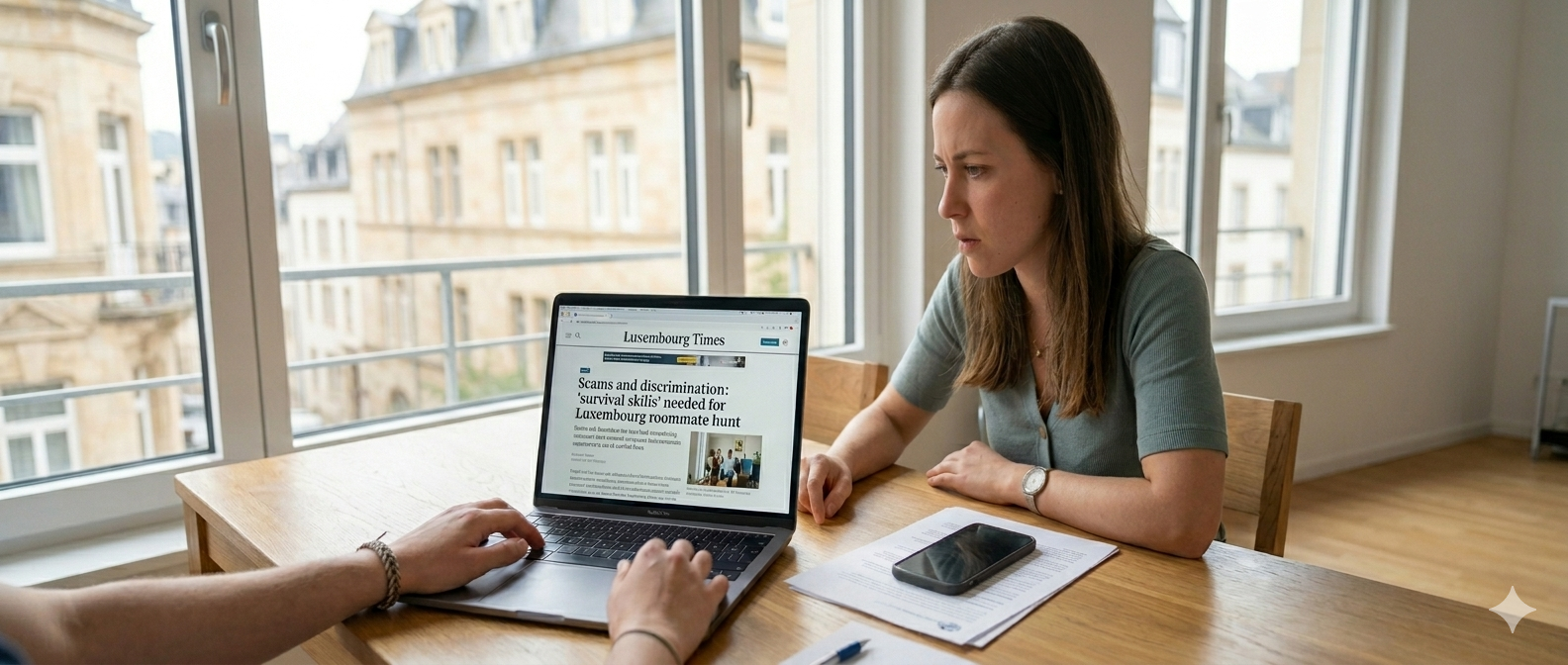
On 21 May 2026, Luxembourg Times published an investigation into the Luxembourg shared room market. The article opens with a tenant who was scammed twice — once for €180, once for a €1,700 deposit that disappeared the day he was supposed to do the état des lieux. His conclusion: "I didn't think finding an apartment needed survival skills."
That sentence captures the problem better than any market statistic.
Luxembourg Times — the English-language edition of Luxemburger Wort, the country's oldest and highest-circulation daily newspaper, founded in 1848 — is not a publication that overreaches in its headlines. When its reporters describe the Luxembourg roommate search as requiring "survival skills," they are documenting something that Roomie-Radar's founders have observed since day one: the shared room market in Luxembourg is fragmented, informal, and structurally exposed to fraud and abuse.
The full article is available at luxtimes.lu. What follows is what it documents, why it matters, and what Roomie-Radar is doing about it.
What Luxembourg Times documented about the shared room market
The article, written by reporter Lucrezia Reale, draws on data from the Luxembourg Housing Observatory, testimonies from tenants, and interviews with the founders of two rental-tech startups — including Roomie-Radar.
The scale of the problem starts with the numbers. According to a Luxembourg Housing Observatory study cited in the article, around 59% of people living in shared accommodation in Luxembourg are between 19 and 35 years old. And 60% of those respondents said shared housing is one of the few remaining affordable options for singles in the country.
That's not a niche. That's the majority profile of the market.
The same Housing Observatory has also warned that co-living and short-term rentals in Luxembourg operate under unclear and inconsistent rules across communes — particularly regarding safety standards, occupancy limits, and the ability of tenants to register at their address. In practice, this means that someone renting a room in a shared flat in Bonnevoie may be operating under different conditions than someone in Kirchberg, with no centralised framework to protect them in either case.
How rental scams work in Luxembourg — and who they target
The article documents the mechanism of rental fraud in the Grand Duchy with precision. Fraudsters copy images from legitimate listings, repost them at attractive prices, and pressure prospective tenants into transferring deposits before any viewing takes place.
Victims are disproportionately students, interns, and newly hired professionals trying to secure housing in Luxembourg from abroad before relocating — exactly the profile most exposed, because they cannot verify listings in person.
Thiago, who spoke to Luxembourg Times while anonymously pursuing legal proceedings against one of the scammers, described both incidents in detail. The first: €180 paid to view a room via a call. The second: a €1,700 deposit transferred for a room viewed over a WhatsApp call from what appeared to be a registered real estate agency. The agent disappeared on the day of the état des lieux.
"I just wanted to have a place on day one," he told the newspaper. "I didn't think finding an apartment needed survival skills."
In Luxembourg's tight rental market, affordable rooms can disappear within hours. The article notes that real estate agents have previously confirmed to Luxembourg Times that up to 30 applicants can respond to a single listing on the day it is published. That competitive pressure forces fast decisions — and fast decisions without verification are exactly the conditions scammers exploit.
The informal mechanics of flatshare searches — and what they cost tenants
Beyond outright fraud, the article documents a secondary problem: the informality of flatmate replacements and deposit transfers between strangers.
Unlike agency-managed leases, roommate replacements in Luxembourg are often organised privately between tenants. Deposits are sometimes transferred directly between individuals without contracts, without inventories, without legal oversight.
Lynn, a finance sector professional in her 30s, described her experience to Luxembourg Times. She and her flatmate applied immediately to every property they visited, keeping a full dossier in email drafts — payslips, documents, a written presentation of themselves — ready to send at a moment's notice. When she came to move out, she found herself waiting for the next tenant to reimburse her deposit. "It is stressful and you never know what people will or will not do," she told the reporter.
Disputes over deposits, furniture damage, and verbal agreements are increasingly common in this informal grey zone of rental practice.
What Roomie-Radar's founders said
Roomie-Radar's co-founders are quoted directly in the Luxembourg Times article. Their diagnosis of the problem is the same one that led them to build the platform.
"Everything still moves informally through Facebook or WhatsApp groups," said Salvador Reynés. "Those channels don't provide any protection or verification mechanisms."
"Many expats arrive in Luxembourg alone and need housing immediately in order to register with the commune and start working," said Javier Geisseler. "When you're searching remotely, you often don't know whether the room really exists or whether the person advertising it is trustworthy."
Both founders arrived in Luxembourg as Spanish expats in 2021 and experienced the fragmentation of the market directly before building Roomie-Radar as a response to it. The platform allows private landlords, tenants searching for replacements, co-living operators, and agencies to upload listings. Tenants can filter by budget, location, lifestyle preferences, and lease flexibility.
The article notes that listings visited or verified by the platform can receive a "verified" label — indicating that the property and landlord have been checked. This is described by the founders as a direct response to the three recurring problems they identified: lack of verification, fragmented communication channels, and inefficient matching between tenants and landlords.
How to Find a Room in Luxembourg Before You Arrive: A Week-by-Week Action Plan
The legal framework that hasn't kept up
The Luxembourg Times article also covers the legal dimension of the problem. The rental legal framework in Luxembourg remains largely designed around traditional household rentals rather than flexible, roommate-based housing arrangements.
Most shared flats in Luxembourg still operate under a single lease shared between multiple occupants, making tenants jointly responsible for the contract unless a different legal structure is formally established. The 2024 rental reform introduced clearer distinctions between co-location and co-living — including rules on shared responsibility and contract termination — but many shared flats still operate outside these frameworks in practice.
"There's still limited flexibility for shared housing," Geisseler told Luxembourg Times, "especially when it comes to allowing individual contracts within small apartments so that tenants can move in and out without affecting the entire group."
"Tenants end up managing replacements and deposits themselves because the legal framework doesn't really cover these situations properly, and landlords allow it. Right now, rental agreements are still largely built around traditional households. That doesn't reflect how people actually live in Luxembourg anymore."
A broader rental reform is expected in Luxembourg by mid-2026, according to confirmation from the housing ministry cited in the article.
Luxembourg Rental Reform 2024: What Changed for Flatshare Tenants and Why It Matters Before You Sign
What this means for anyone searching for a room in Luxembourg
The Luxembourg Times investigation confirms, through independent journalism, what any expat who has searched for a shared room in Luxembourg already knows: the market is not designed for people arriving alone, from abroad, under time pressure.
The fragmentation is structural. The scam risk is documented. The deposit informality is standard practice. And the legal framework has not yet adapted to the way people actually live.
Roomie-Radar exists as a direct response to each of those problems: verified listings, direct access to landlords, a platform built for people who cannot afford to get it wrong in their first weeks in the country.
Using Roomie-Radar is free. Verified listings for rooms in Luxembourg are at roomie-radar.com/rooms.
Conclusion
When Luxembourg Times titles an investigation "survival skills needed for Luxembourg roommate hunt," it is not writing about an exceptional situation. It is documenting the standard experience of thousands of expats arriving in Luxembourg every year.
The Housing Observatory data, the tenant testimonies, and the quotes from Roomie-Radar's founders all point in the same direction: a market that functions on informality, pressure, and the absence of verification — and that has real financial and personal consequences for the people navigating it without local knowledge or contacts.
That's the problem Roomie-Radar was built to reduce. Not eliminate overnight — but reduce, systematically, one verified listing at a time.
Read the full article at luxtimes.lu. Browse verified rooms at roomie-radar.com/rooms.
FAQ 📊
1. Where can I read the Luxembourg Times article about Roomie-Radar?
The full article, titled "Scams and discrimination: 'survival skills' needed for Luxembourg roommate hunt," was published by Luxembourg Times on 21 May 2026. It is available at luxtimes.lu. Luxembourg Times is the English-language edition of Luxemburger Wort, Luxembourg's oldest and highest-circulation daily newspaper.
2. What does the Luxembourg Housing Observatory data say about shared housing in Luxembourg?
According to a Housing Observatory study cited in the Luxembourg Times article, around 59% of people in shared accommodation in Luxembourg are between 19 and 35 years old. 60% of those respondents said shared housing is one of the few remaining affordable options for singles in the country. The same body has also warned that co-living and short-term rentals operate under unclear and inconsistent rules across communes regarding safety, occupancy limits and tenant registration.
3. How do rental scams typically work in Luxembourg?
The most common pattern documented by Luxembourg Times: fraudsters copy images from real listings, repost them at below-market prices, and pressure prospective tenants to transfer deposits before any visit takes place. Victims are typically students, interns or newly hired professionals searching from abroad. The fraud only becomes apparent when the tenant arrives and finds the property either does not exist or was never available.
4. How can I protect myself from rental scams when searching for a room in Luxembourg?
Never transfer a deposit before signing a contract and completing an état des lieux in person. Be sceptical of prices significantly below market rate. Verify the landlord's identity before any financial transaction. Use platforms with verified listings — on Roomie-Radar, listings go through a verification process before becoming visible to tenants.
5. What did Roomie-Radar's founders say in the Luxembourg Times article?
Both co-founders were interviewed. Salvador Reynés noted that everything in the Luxembourg shared room market still moves informally through Facebook and WhatsApp groups, which provide no protection or verification for tenants. Javier Geisseler explained that many expats arrive needing housing immediately to register with their commune and start working, but when searching remotely they have no reliable way to verify whether a listing is real or the landlord is trustworthy.
6. What is the état des lieux and why does it matter in Luxembourg?
The état des lieux is a condition inventory of the property, signed by both landlord and tenant on entry and exit. It is the document that determines whether a tenant is responsible for any damage at the end of the lease. In the scam cases documented by Luxembourg Times, the fraudster disappeared on the day the état des lieux was supposed to take place — before any keys were handed over.
7. What changes did the 2024 Luxembourg rental reform introduce for shared flats?
The 2024 reform introduced clearer legal distinctions between co-location (shared lease, joint liability) and co-living (individual contracts per tenant, reduced joint liability). However, many shared flats in Luxembourg still operate outside these clearer frameworks in practice. A broader rental reform is expected by mid-2026. Full details on the 2024 reform are available in the Roomie-Radar article on the topic.
8. How does Roomie-Radar's verification work?
Landlords publish their listings on the platform. Before a listing becomes visible to tenants searching for rooms, Roomie-Radar carries out a verification process covering the property and landlord. Listings that pass this process receive a verified label. Using Roomie-Radar is free.
9. Is Roomie-Radar the only platform addressing this problem in Luxembourg?
Luxembourg Times also mentions other platforms operating in the Luxembourg rental market. Roomie-Radar's specific focus is verified listings in shared flats and co-living — a segment the article identifies as particularly exposed to fraud and informality. The platform was built by expats who experienced the problem directly, which shapes how it approaches matching, verification, and tenant communication.
10. What should I do if I have already been the victim of a rental scam in Luxembourg?
Do not make further payments. Document all communications, payment records and the listing itself. Contact Luxembourg's consumer union (ULC) for guidance on legal proceedings. If the scammer posed as a real estate agency, report to the relevant professional body and, where applicable, to the police. Luxembourg Times has previously published resources on the most common scams in Luxembourg and how to report them.